

Subscribe to our "Population in Perspective" Substack Here!

Two recent publications by Sander Wagner (Leverhulme Centre for Demographic Science) provide new evidence on how becoming a mother affects women’s careers, and why these effects matter for gender inequality more broadly. Both studies draw on large-scale administrative labour market data from France and Germany that were harmonised by the authoring team under a DFG–ANR research grant, with the aim of making cross-national research using administrative records more feasible.
Study 1: Motherhood Penalties and Gender Inequality
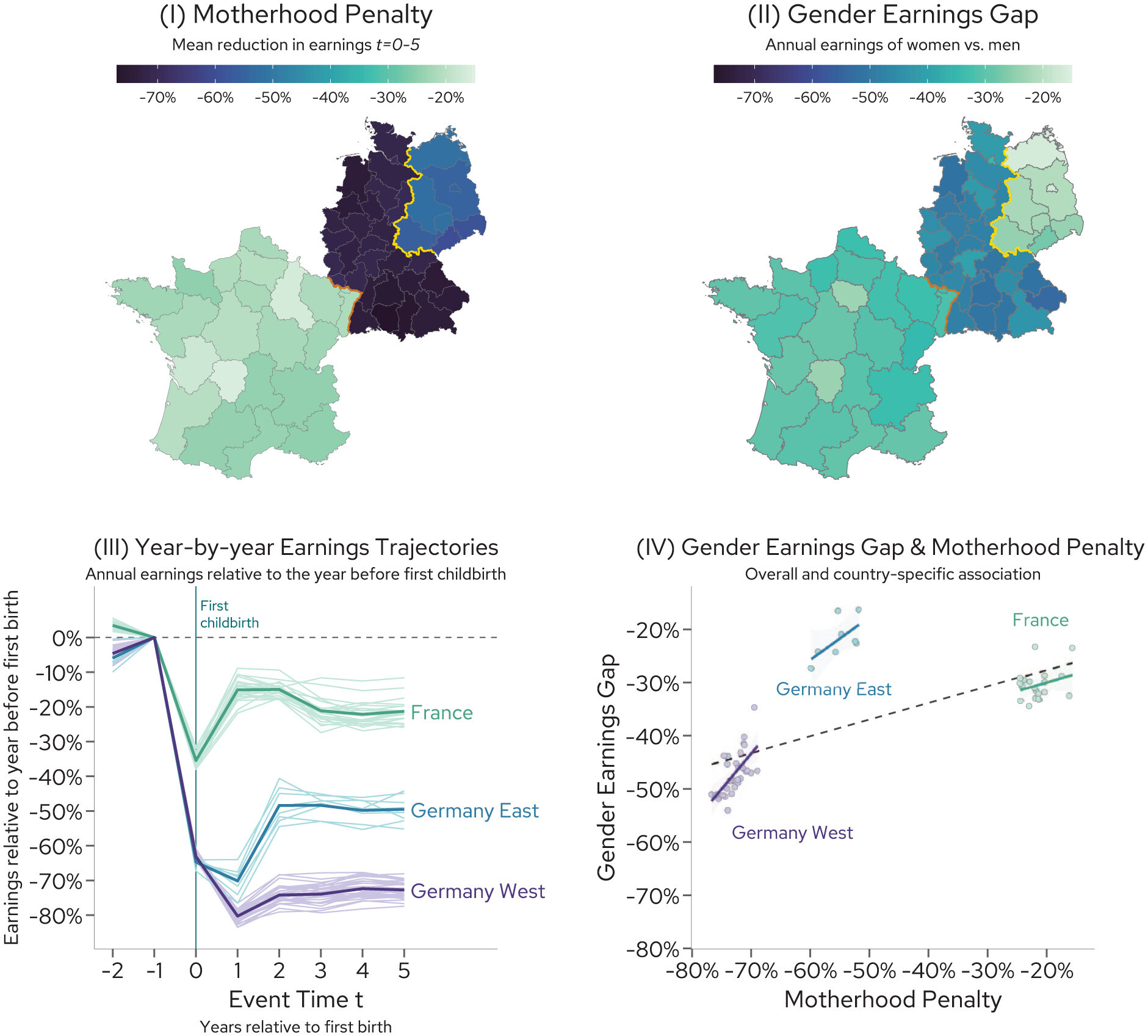
In a first study, “Gender Inequalities and Motherhood Penalties across French and German Local Labor Markets,” published in Socius: Sociological Research for a Dynamic World, Dr. Wagner and colleagues show that the “motherhood penalty” plays a central role in shaping gender pay gaps. The motherhood penalty refers to the decline in women’s earnings and employment that often follows the birth of a child. While it is widely seen as a major driver of gender inequality, direct evidence linking post-birth career setbacks to overall gender gaps across the workforce has long been limited.
The study measures both mothers’ earnings losses and gender pay gaps across NUTS-2 regions in France and Germany. The analysis reveals a strikingly strong relationship: regions where mothers experience larger penalties consistently display wider gender earnings gaps (see figure). This pattern holds both between and within countries. Within a given country, a region with a motherhood penalty twice as large as another can expect a gender pay gap that is around 70 percent wider.
As Dr Wagner explains: “Everything we know about the importance of motherhood led us to expect a link between post-birth career penalties and gender inequality. Still, it is rare to find such a clear and strong association across labour markets, and we were surprised by the magnitude of the relationship we uncovered.”
The findings underline that what happens to women’s careers after childbirth is a key driver of persistent gender inequality in the labour market. They also send a clear message to policymakers: increasing the compatibility of work and family life is central to achieving greater gender equality in labour markets.
Study 2: Social Stratification of Motherhood Penalties
A second study, published in Research in Social Stratification and Mobility, examines which mothers are most affected by these penalties. Dr Wagner and his co-authors follow women for five years after their first birth and analyse how post-birth employment losses vary by socio-economic background.
The study confirms that overall penalties are much larger in Germany than in France. However, it also uncovers an unexpected pattern: the smaller French penalties are more strongly stratified by income and education, while the larger German penalties are more evenly distributed across social groups. In France, women with lower pre-birth incomes experience substantially larger and more persistent employment losses than more advantaged mothers.
Dr Andreas Filser, who recently visited LCDS to present this work and advance the collaboration with Dr. Wagner, notes: “We initially expected the much larger German penalties to be more strongly stratified. Instead, we found that it is the smaller French penalties that are more unequal. This complicates our picture of how motherhood penalties contribute to broader inequalities.”
Together, the two studies show that motherhood penalties are central to understanding gender inequality in the labour market. They illustrate how these penalties vary across countries and regions, as well as across social groups. By combining harmonised administrative data with detailed regional and socioeconomic analyses, the research strengthens the evidence base on the crucial role that motherhood continues to play in shaping labour market stratification across Europe.
Read the studies here:
Wagner et al. (2026). Gender Inequalities and Motherhood Penalties across French and German Local Labor Markets. Socius: Sociological Research for a Dynamic World.
Filser et al. (2026). Stratification of Post-Birth Labour Supply in a High- and Low-Maternal Employment Regime. Research in Social Stratification and Mobility.