

Subscribe to our "Population in Perspective" Substack Here!
Five years after the onset of the COVID-19 pandemic, an important question remains: was COVID-19 a short-lived mortality shock, or has it more permanently altered life expectancy trajectories? A new preprint by LCDS Deputy Director Jennifer Dowd and LCDS affiliates Antonino Polizzi, José Manuel Aburto, Hannaliis Jaadla, Haohao Lei, and Ridhi Kashyap, along with co-lead author Jonas Schöley from the Max Planck Institute for Demographic Research, updates life expectancy estimates through 2024 for 34 high-income countries.
By comparing observed life expectancy to counterfactual forecasts based on pre-pandemic trends, the study calculates annual and cumulative “life expectancy deficits” — the gap between expected and observed life expectancy in the absence of COVID-19.
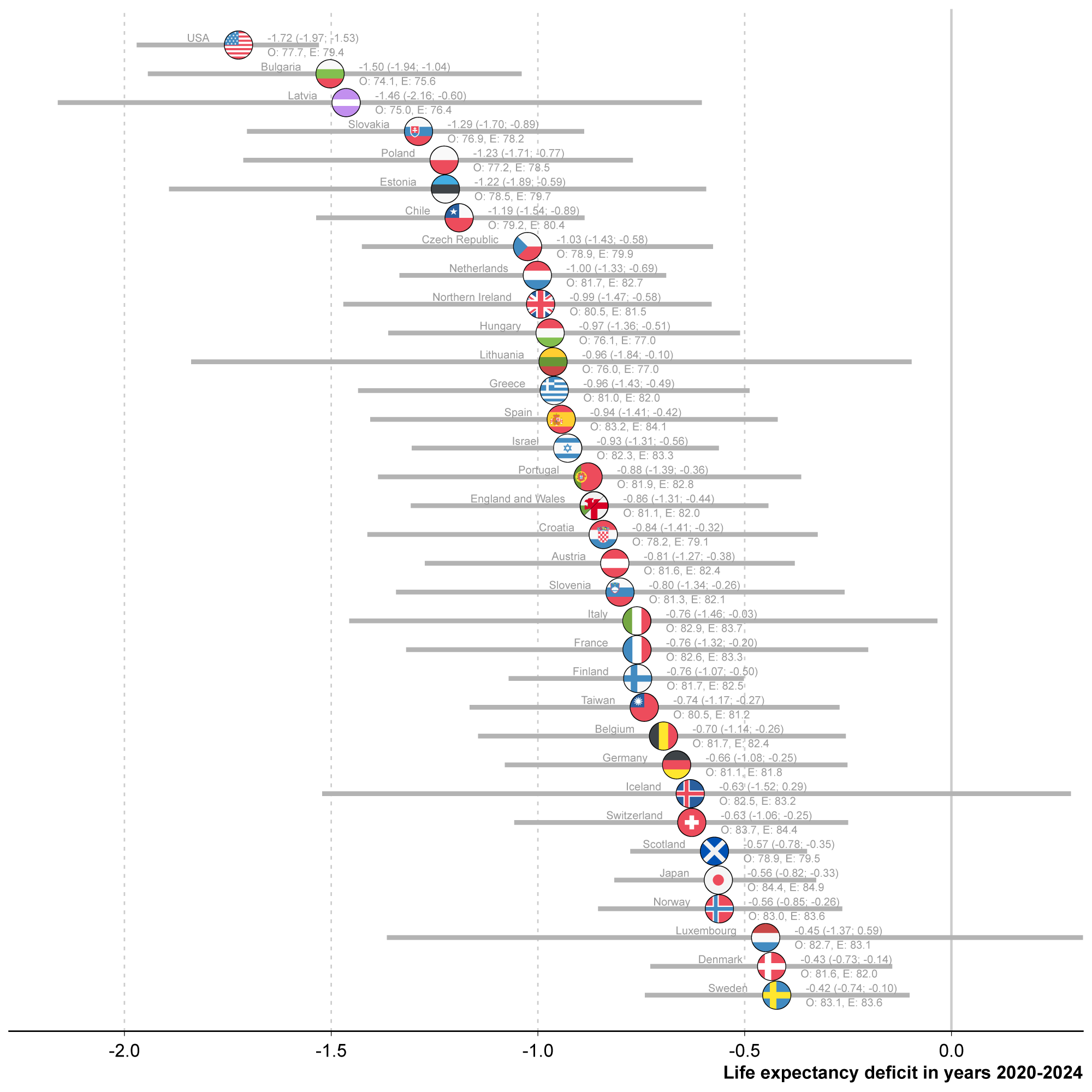
The findings suggest that recovery remains incomplete in most countries. In 2024, 31 out of 34 countries still had lower life expectancy than expected based on pre-pandemic trends.
Rather than a uniform rebound, the researchers identify four distinct patterns of disruption: early severe losses followed by recovery, sharp second-wave peaks with large cumulative deficits (including the USA and parts of Eastern Europe), delayed mortality peaks, and prolonged periods of persistent deficits. In general, countries with severe second-wave peaks (such as the USA and Bulgaria) had the largest cumulative losses. In contrast, countries that delayed widespread infection (e.g., Norway, Japan) saw later deficits that persisted through 2024, but with lower cumulative mortality.
Professor Jennifer Dowd explains:
“Historically, life expectancy declines have often been followed by rapid rebounds. What we see here is much more complex. Five years on, most high-income countries have not fully returned to their pre-pandemic trajectories, raising the possibility that COVID-19 will leave a more lasting scar on population health and life expectancy trajectories."
Read the full preprint here:
https://www.medrxiv.org/content/10.64898/2026.02.25.26347112v1
This paper is a preprint