

Subscribe to our "Population in Perspective" Substack Here!
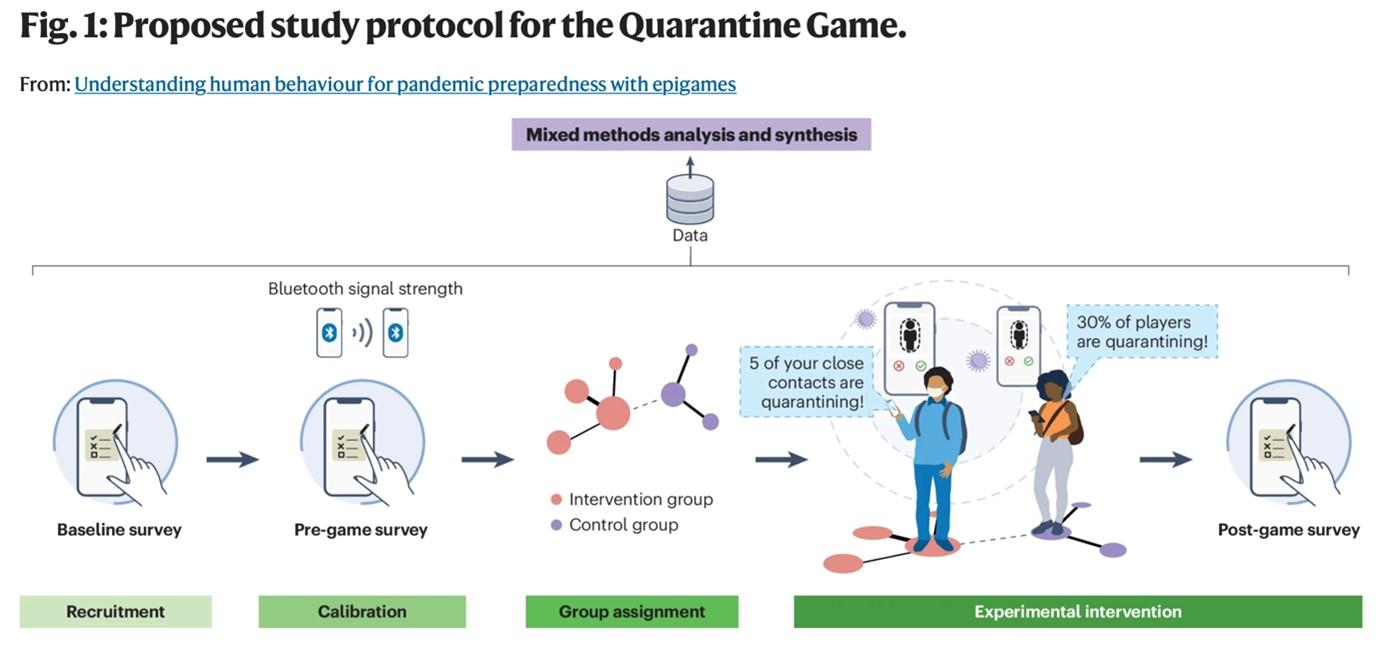
Researchers from the Leverhulme Centre for Demographic Science (LCDS), Oxford Population Health at the University of Oxford, working with colleagues from the Pandemic Sciences Institute and international partners, have proposed a groundbreaking new approach to pandemic preparedness: experimental “epigames” that combine behavioural science, network analysis and digital technology to better understand how infectious diseases spread through real-world social networks.
Published in Nature Health, the article outlines how smartphone-based epidemic games can simulate outbreaks in naturalistic settings such as university campuses, workplaces and conferences. Participants interact through a gamified app that uses Bluetooth signals to measure proximity and contact duration, while also capturing behavioural decisions such as whether to isolate, vaccinate or test.
The approach generates four integrated data streams: high-resolution contact networks, in-game behavioural decisions, attitudinal survey data, and contextual environmental information. It builds on previous LCDS work (Nature Human Behaviour) on the importance of social networks for understanding transmission dynamics. Together, these data offer an unprecedented opportunity to bridge a longstanding gap between epidemiological models and the human behaviours that drive transmission dynamics.
The project is part of the Oxford Martin School’s Digital Pandemic Preparedness programme, which supports innovative tools to strengthen readiness for future outbreaks. This includes co-authors Professor Melinda Mills, Professor Christophe Fraser and Dr Luca Ferretti who focus on advancing digital approaches to epidemic modelling and real-time outbreak analysis, by embedding behavioural experimentation directly into transmission research.
Professor Melinda Mills, Director of the Leverhulme Centre for Demographic Science and co-author of the paper, said:
“COVID-19 exposed a critical weakness in our pandemic toolkit: while we can now sequence pathogens at extraordinary speed, we still lack scalable, rigorous methods to understand how human behaviour shapes transmission. Epigames represent a transformative step forward, allowing us to capture real-world contact networks and behavioural responses simultaneously. This integration is essential if we are to build models that truly reflect how societies function during outbreaks.”
Unlike traditional contact diaries or sensor studies that focus only on physical proximity, epigames explicitly incorporates decision-making, incentives and social influence. The framework enables researchers to experimentally test how peer norms, risk perception and policy nudges alter both behaviour and network structure. By doing so, it lays the foundation for more realistic agent-based epidemic models that integrate biological, behavioural and environmental factors.
The authors argue that just as genomic sequencing became a global priority during COVID-19, digital behavioural–epidemiological experimentation should now be elevated as a core capability in pandemic preparedness.
The interdisciplinary collaboration spans epidemiology, demography, behavioural science, network theory, computer science and game design — reflecting the scale of innovation needed to prepare for the next global health crisis.
The article, published in Nature Health is available here
Colubri, A., D. Williams, T. Valente, C.T. Bauch, J.M. Drake, M.C. Mills, J. Drury, C. Fraser, L. Ferretti & J. Panovska-Griffiths. (2026). Understanding human behaviour for pandemic preparedness with epigames, Nature Health, https://doi.org/10.1038/s44360-026-00071-8